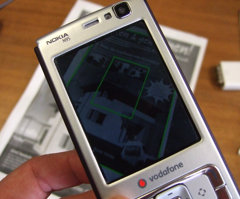
This paper presents a system which combines smartphones with networked infrastructure and fixed sensors and shows how these elements can be combined to deliver real-time augmented reality. We use a Kinect to generate dynamic trackable models of the environment as it changes at video frame rate.
[ISMAR 2012 paper]
This paper shows how a user can rapidly construct a 3D model that can be used for visual tracking. The system uses point features for initialization and edge features for tracking.
[2011 Machine Vision and Applications paper]
Simon and Connell have launched their mobile Augmented Reality software called Popcode . Now available for iOS devices as well as Android.
Now called Zappar.
This paper presented two methods (Ferns and SIFT) for fast matching of feature points between live video and a stored planar scene. The methods ran at more than 10Hz on mobile phones with limited processing capability. This work won the best paper prize at ISMAR 2008.
[Prizewinning 2008 ISMAR paper]
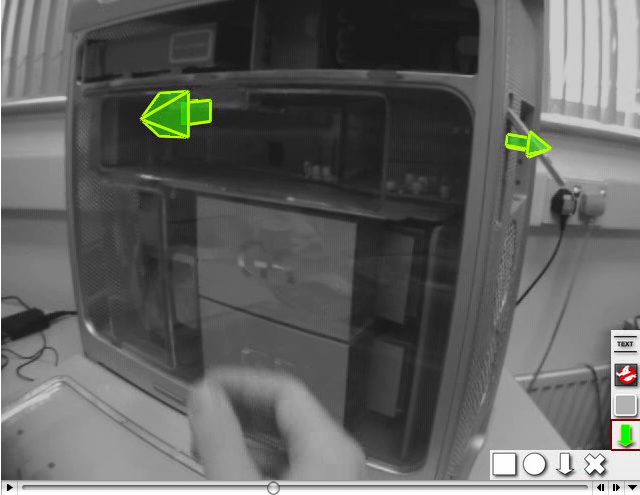
This work enables Augmented Reality applications to operate in unknown environments. The environment is mapped simultaneiously with localisation of the camera using a SLAM system which also assists the user in the placement of authored annotations. A key application domain for this technology is the provision of remote expertise. The system supports this use by communicating the video and annotations over a network link, thus providing an enriched communication channel between user and remote expert.
[2007 ISMAR Paper]
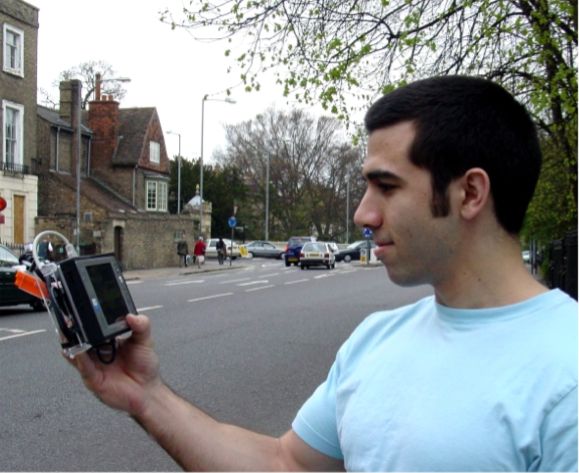
This work performs edge-based visual tracking in outdoor environments. The system uses a textured model which is rendered using GL. Edges are extracted from this rendering and correspondences are then found in the live video, thus providing automatic detail culling. The system also exploits inertia information and recovery mechanisms based on stored key-frames to provide a robust tracking solution for outdoor augmented reality.
[2006 ISMAR Paper]
This method we created identifies handheld devices (e.g. smart phones and pocket PCs) to facilitate the use of these devices as tangible interfaces for desktop augmented reality systems. The proposed system leverages the ability of these handheld devices to programmatically control their backlight intensity to display a binary code. The codes produced are non-intrusive, require no specialized hardware, and can be generated with most handheld devices. This technique is shown to accurately and robustly identify up to 16 different devices in under 500 msec and is easily expandable to 256 or more devices.
[2006 ISMAR Paper]
This work focuses on developing hybrid tracking and spatial reference technologies which can be combined to deliver new human-machine interfaces. The project focuses on creating algorithms for tracking objects so that graphics can be overlaid on the image allowing a user to interact with it. The object localization system utilizes both image tracking and an inertial rate gyroscope unit to robustly track objects.
[140M Video] [4.2M Video]
Paper maps are much higher resolution than computerised maps and can be more readily manipulated. However, because they are physically printed they can only show static information. This work makes use of a camera-projector system to allow overlay of dynamic information on paper maps placed on a table surface. Tangible user interface tools are supported in a manner which allows multiple concurrent users to interact with the same map.
[2005 ISMAR Paper]
Tablet PCs offer an alternative to head-mounted displays for delivering augmented reality. This work shows a tablet-based AR application which combines inside-out edge tracking and outside-in LED tracking for robust registration: the inside-out system provides a high level of registration accuracy while the outside-in system provides robustness and recovery from shake and camera occlusions. To provide a high level of rendering quality, we look at the specific case of virtual graphics occluded by real objects for which we have a model. We show that instead of just clipping virtual graphics using the real geometry projected into the z-buffer, an individual treatment and refinement of occluding edges produces a far more convincing integration of real and virtual objects.
[2004 ISMAR Paper]
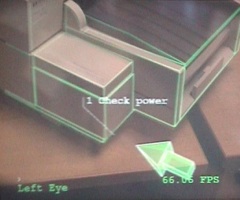
Edge-based visual tracking was applied to a system with a head-mounted camera and intertia unit. The system is used to calibrate a user's view of the world through a Head Mounted Display (HMD) with computer graphics displayed on the HMD. A protoype application was then developed which displayed instructions to the user over real world objects.
[2003 ISMAR Paper] [video of prototype application]